
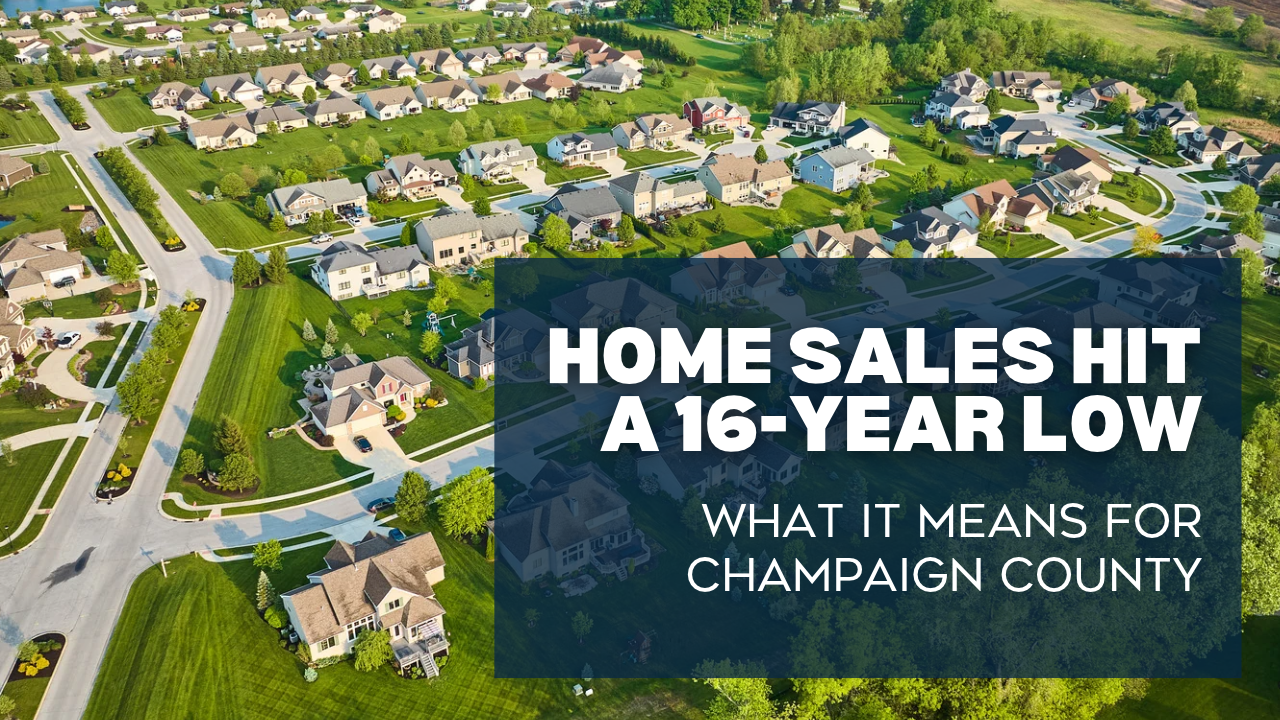
National home sales are at their lowest pace since 2010. But the numbers tell a more complicated story—and Champaign County offers an important local perspective.
Home sales have fallen to their lowest pace in more than 16 years. That’s an attention-grabbing headline, especially for anyone who remembers the housing crisis.
But here’s what I find interesting: Fewer homes are selling, yet many existing homeowners remain in a strong financial position. How can both be true? And what does that mean for buyers and sellers here in Mahomet, Champaign, Urbana, and Savoy?
🏡 The Quick Take: October 2026 Housing Market
- National existing-home sales: 3.75 million at a seasonally adjusted annual rate, down 5.5% from September and 8.8% from October 2025.
- National inventory: 1.59 million homes, up 4.6% year over year.
- Months of supply: 5.1 nationally.
- Distressed transactions: Just 2% of existing-home sales, according to NAR.
- Champaign County: October closed sales declined 26.2% year over year, while the rolling 12-month median price rose 4.2% to $250,000.
Bottom line: A slowdown in transactions isn’t the same thing as a collapse in home values or homeowner finances. And local conditions matter far more than a national headline when you’re making a real estate decision.
What the National Housing Numbers Actually Tell Us
The National Association of REALTORS® reported an October 2026 existing-home sales pace of 3.75 million, seasonally adjusted and annualized. That was down 5.5% from September and 8.8% from a year earlier.
Meanwhile, 1.59 million existing homes were available for sale, 4.6% more than in October 2025. At the current sales pace, that represented 5.1 months of inventory.
More inventory relative to sales gives buyers more choices. It can also mean sellers face greater competition. But it does not automatically tell us that every home is losing value.
Why Homeowners May Be Financially Comfortable Even When Sales Are Slow
NAR Chief Economist Lawrence Yun highlighted another important part of this story: roughly 88 million homeowners have accumulated substantial housing wealth, and distressed sales remain historically low—just 2% of transactions in October.
Some owners purchased years ago, have paid down their mortgages, or have benefited from long-term appreciation. Others have low fixed mortgage rates and little incentive to exchange those payments for a more expensive loan.
A homeowner’s financial position and a home’s ability to sell at a particular asking price are two different things. Someone can have significant equity and still need to adjust their price to compete for today’s buyers.
What About Buyers?
For buyers, affordability remains a major challenge. Mortgage rates affect purchasing power, and higher monthly payments can keep otherwise interested households on the sidelines.
More available homes may create room to compare properties, negotiate, and make a thoughtful decision. But the opportunity depends on the specific neighborhood, price range, condition, and financing—not just national inventory.
Here’s What We’re Seeing in Champaign County
I recently analyzed October 2026 data for Champaign County. The local picture shares some similarities with the national slowdown, but it is not identical.
October closed sales fell from 191 in 2025 to 141 in 2026—a 26.2% decline. Yet when we compare the rolling 12-month periods, closed sales slipped just 1.8%, from 2,110 to 2,071. One month looked much weaker than the broader year.
At the same time, the rolling 12-month median sale price increased from $240,000 to $250,000, a 4.2% gain. Months of supply increased from 1.5 to 2.0, and the average percentage of original list price received declined from 98.2% to 96.9%.
Those statistics don’t mean every home appreciated by 4.2%. The median reflects the mix of properties sold, and individual homes can behave differently. But they do illustrate why falling sales activity shouldn’t be confused with falling property values.
And Mahomet Is Different From Champaign County Overall
Mahomet is a good example of why I study communities separately. During the 12 months ending October 2026, 190 homes sold there—up 7.3% from the preceding 12 months. The rolling median price, however, declined 1.9% to $382,500.
Mahomet’s October inventory rose from 40 to 63 homes, and months of supply increased from 2.6 to 3.9. That creates a different competitive environment than the countywide 2.0 months of supply.
And even those communitywide figures can’t tell you how a particular three-bedroom ranch, new construction home, or lakefront property will perform. The relevant competition is specific to the home and its price range.
What This Means If You’re Selling
I wouldn’t view the national headline as a reason to panic. But I also wouldn’t use accumulated equity as a substitute for a current pricing strategy.
Before recommending a list price, I study recent comparable sales, active competing listings, and how long similar homes are taking to go under contract. I also look at how a property is positioned relative to alternatives a buyer could purchase today.
Preparation, presentation, and marketing matter. So does recognizing when the market is telling us that a property’s asking price needs attention.
If you’re considering a move next spring, you can also read my guide to preparing your Champaign County home for spring 2027.
Are We Heading Toward Another Housing Crash?
It’s understandable that a comparison with 2010 raises concerns. But a low number of transactions is not, by itself, evidence that today’s market has the same underlying financial conditions as the housing crisis.
The small share of distressed transactions is an important difference. That doesn’t rule out local price declines or financial strain for individual households. It simply means we need more than one statistic before drawing conclusions.
My Take: The Housing Market Isn’t One Market
A first-time buyer may be struggling with affordability. A longtime homeowner may have substantial equity. A seller may have a valuable property but need to rethink the asking price. And a financially prepared buyer may find more options than a year ago.
All of those things can be true at the same time.
National housing data provides context. Local market data helps us make decisions. That’s why I believe buyers and sellers deserve more than headlines—they deserve a clear explanation of what the numbers mean for their particular situation.
Explore My Fall 2026 Local Housing Market Updates
- Champaign County Real Estate Market Update — Fall 2026
- Mahomet Real Estate Market Update — Fall 2026
- Champaign Real Estate Market Update — Fall 2026
- Urbana Real Estate Market Update — Fall 2026
- Savoy Real Estate Market Update — Fall 2026
Thinking About Buying or Selling in Champaign County?
I’m Jayme Ahlden, REALTOR® with Coldwell Banker Real Estate Group and a local housing analyst serving Mahomet, Champaign, Urbana, Savoy, and surrounding communities. I study the numbers and turn them into practical information to help you make informed decisions. If you’d like to understand what today’s market means for your home or your next move, I’d be happy to help.
Sources: National Association of REALTORS®, October 2026 Existing-Home Sales data and commentary from Chief Economist Lawrence Yun; InfoSparks, Champaign County and Mahomet market data through October 2026. Local rolling 12-month statistics are distinguished from October-only figures.
Leave a Reply